Designing food waste out of recipes with chef Vojtech Végh
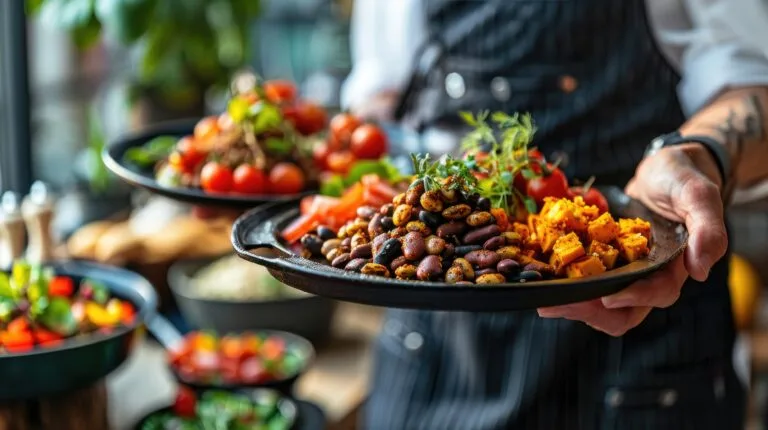
How an international chef is teaching kitchen staff to use rinds and seeds to slice the amount of food going to the bin.
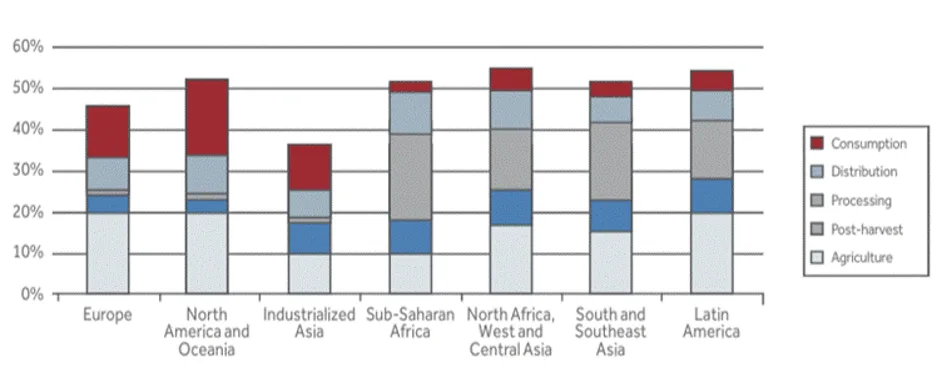
Food waste is an international problem, but it doesn’t look the same in every part of the world. In North America and Europe, for example, a big portion of the waste comes from consumers, while in Sub-Saharan Africa most of the waste comes from processing.
The UN estimates that, globally, 1 billion meals of edible food are thrown away by households every single day. If that wasn’t bad enough, only about 5% of the world’s trash is composted, which means that the majority of the food that goes uneaten is sent to landfills. There, the anaerobic digestion happens (the trash is consumed by bacteria that don’t need oxygen to live). Hence, methane is produced. The problem is that methane is a powerful greenhouse gas, so an abundance of it in the atmosphere contributes to climate change.
Pondering about this problem, Vojtech Véghfound a business opportunity: to turn waste into money – not just for him, but for his clients too.
Vojetch is a zero-waste and plant-based chef, author of the book Surplus: The Food Waste Guide for Chefs, and founder of the world’s first zero-waste and vegan restaurant. He has consulted for major chains such as Accor, Fairmont, Four Seasons and Hilton and helped them reduce food waste in their kitchen. He is also the zero-waste culinary advisor for Winnow.
This interview has been edited for length and clarity.
Desiree: What’s the first thing you analyze when a new client hires you to decrease food waste in their kitchen?
Vojtech: Well, I need some food waste data.
The first step is always to understand where most of the food waste is created. Whether it’s a particular ingredient, a particular meal or a particular food waste category, whether it’s preparation waste, trimming waste… If it’s trimming waste, then [I look at] which ingredient created the trimming and we go from there. This is always the first thing. I need to know what is in the bin.
D: When you get hired to help decrease food waste, do you also help them improve and expand their plant-based options?
V: Everything that I do, whether I do a tasting, a masterclass or I cook for someone, is vegan by default. Then I also do separate plant-based training. If the client is interested in exploring how to cook better plant-based meals, and how to cook higher quality plant-based dishes, we can do that as well. But the majority of my work these days is around food waste.
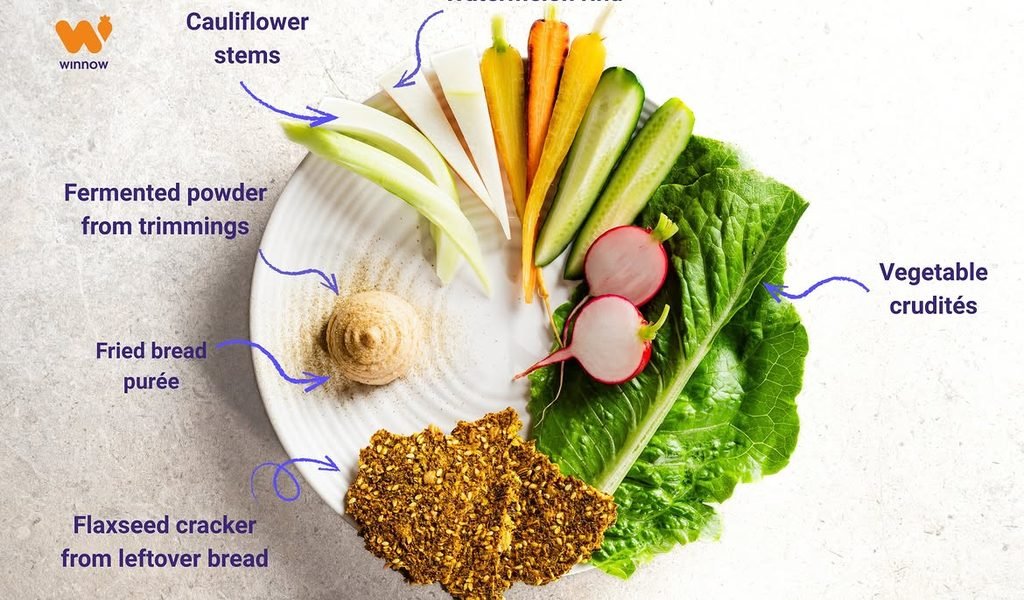
D: Do you also recommend other sustainability initiatives to your clients such as buying only local ingredients and composting?
V: Buying local ingredients, yes. Composting, not necessarily.
Depends on the context, because I don’t consider composting as a solution. So composting is only when there is something that is not suitable for human consumption anymore. And we need to be very clear about that because composting is not a solution to food waste.
If the food has gone into the compost bin, that’s still wasted. That’s the reason I don’t recommend it as the first option.
If the client is already doing something for their food waste and for sustainability and they understand the reason why you should have the composting bin or shouldn’t, then yes, go for it. Have it. Because you will need it at one point anyway because you can’t eat everything.
But it’s never the first step. Composting creates this kind of comforting feeling for the chefs. It makes you feel like you’re doing the right thing. It makes you feel like, “oh, it’s good for nature”. Well, it’s not because the ingredients that are in your kitchen have been grown to be eaten by humans, not by a composting machine. So, [composting]’s a secondary solution. When I speak about food waste or do any kind of work with clients, I focus on preventing food waste. I focus on what is created in their kitchen. Only after, if there is interest, is when I bring in the other [sustainable] things that they can do.
From my perspective, buying local and buying organic is not something that should even be discussed anymore. It’s an obvious thing.
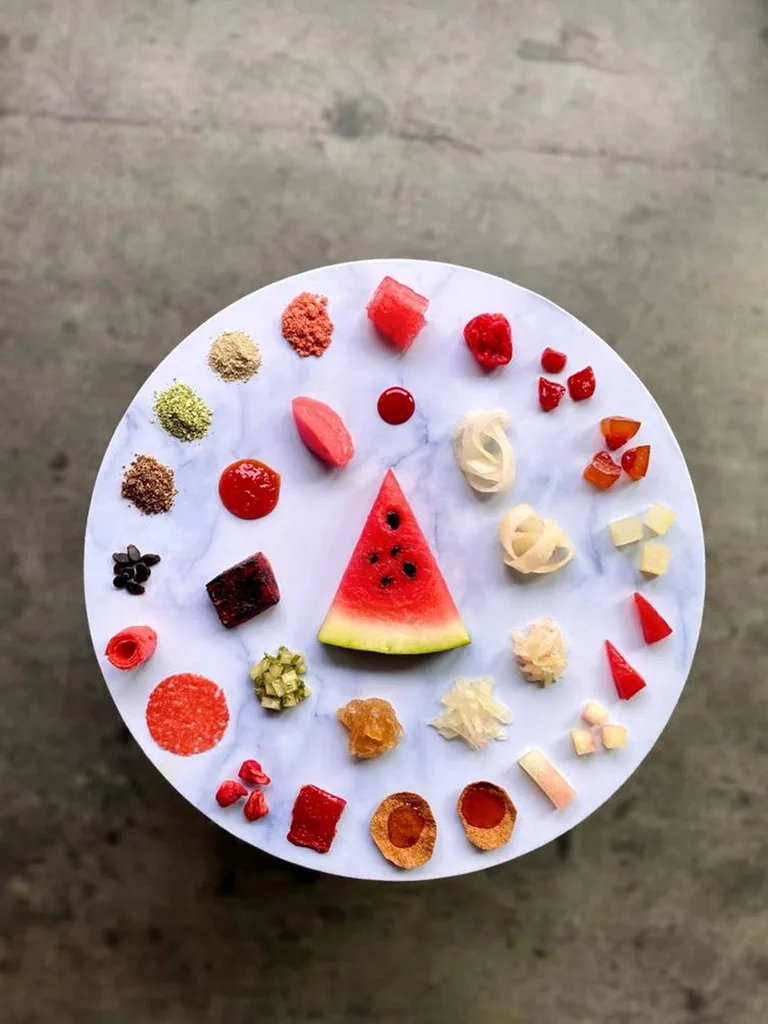
D: Can you explain what’s going on in this picture?
V: Yeah. It’s 31 different ways of [using] the watermelon, including the watermelon rind, prepared in multiple different ways. The way that I use this photo is to inspire chefs to do more with their ingredients and their byproducts as well.
First of all, stop calling those “byproducts”, because they are essentially just like the [main] products and can be used in different ways.
So, the idea that I share with them is that they can choose one or two of those options. Not 30 different ways of [using] the watermelon, that’s not the point. You want to find one or two things that can become the starting point for you to see what you like in your kitchen. And this is how I use those pictures: to inspire chefs and show the possibilities for every ingredient.
D: What’s your creative process like from the moment you look at an ingredient to the time you come up with 30 different ways of using it?
V: A lot of experimenting, seeing what the possibilities are.
I do have a framework to simplify the process. But it’s just trying it out, you know, you take an ingredient and see what’s possible. There are a lot of things that I already know because I’ve been working in the kitchen, but then there are some new things that I try out.
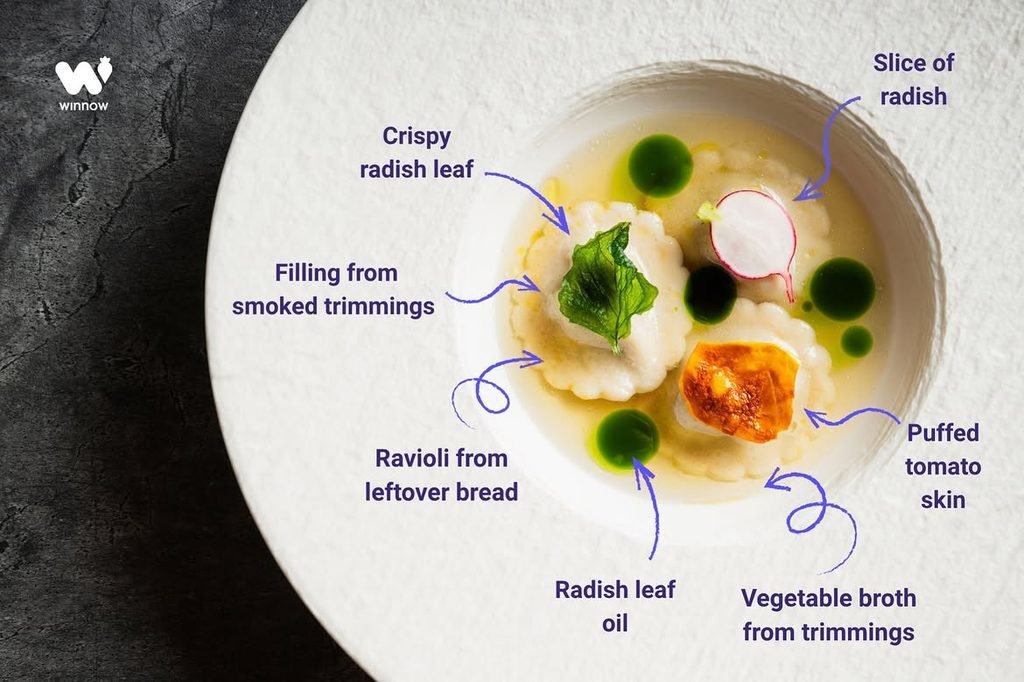
First, I try to focus the plate around that ingredient byproduct whenever possible. I try to utilize the byproduct in more ways than the product itself, if I can. And the second thing is the kind of products that I showcase on a plate. I want them to be things that chefs can easily replicate in the kitchen. Or things that other people can do as well, so there aren’t super crazy things. Some are fairly simple and can be reproduced in the kitchen. That’s the way that I look at it.
It’s been a couple of years since I started this project, and I’ve done like 70 of those plates. Now I can see even more ways of using some of the ingredients, so I might be doing a refresh of some of these sometime soon.
D: How do you calculate the monetary savings your clients are generating from decreasing food waste? Is it by weight?
V: I don’t calculate it, the [clients] calculate it. It really depends on the food waste data that they have – and, ideally, they have some food waste data. If they don’t, then everything is just an estimate, because you don’t really know.
If they have food waste measurement tools, like automated tools, then that’s very easy, because everything is connected to the system. You see the savings immediately, you don’t need to calculate it, [the system] does it for you. This is the ideal setup, when we just have the numbers right away.
If you must do an estimate, then you take the top 10 or 20 most wasted ingredients, and you calculate the average purchase cost of those ingredients together per kilo. So, 100 kilos of products cost you, let’s say, $400. If you waste 10% of the ingredient, then you’ve wasted $40. That is before any margins are added.
That means that you would need to save 10 kilos of byproducts from the waste bin, which is easy. You made $40 on those 10 kilos, basically, plus the potential margin [charged from the customers] that you’re going to be adding to it.
When you work with large resorts, big groups, big contract caterers and casinos, the savings are in six, seven figures on a yearly basis. There is a lot of money in it.
D: Most food waste goes to landfills and generates methane, a powerful greenhouse gas. Have you calculated how much greenhouse gas emissions you have helped avoid by training kitchen staff around the world?
V: No, not at all.
A lot of clients have separate kinds of certifications and accreditations consistent with the initiatives. They can always calculate, but what I do is quite restricted to training the chefs.
—
Now it’s your turn to take a look at your kitchen and experiment with the parts of ingredients you once thought to be “byproducts”. Whether you make jelly out of guava skin or slice broccoli stems to make fries, you can show your friends and family how saving the planet can be tasty and good for your wallet!

Did you enjoy our content and want to use part of this article? Don’t forget to cite us!
Find out how to include it in your references:
IZECKSOHN, Desiree. Designing food waste out of recipes with chef Vojtech Végh. Autossustentável. Available at: <https://autossustentavel.com/2026/09/designing-food-waste-out-of-recipes-with-chef-vojtech-vegh.html>.